Cookie Consent
By clicking “Accept”, you agree to the storing of cookies on your device to enhance site navigation, analyze site usage, and assist in our marketing efforts. View our Privacy Policy for more information.

For two decades, "showing up in search" basically meant one thing: ranking on Google. You typed something into the box, you got ten blue links, and the brands that knew SEO won the click.
That world still exists. It's just no longer the whole map. People now ask ChatGPT for product recommendations, read Google's AI Overviews instead of clicking through, and let voice assistants answer quick questions out loud. Each of those moments is a chance to be discovered, and each one plays by slightly different rules.
That's why two new acronyms keep appearing next to SEO: AEO (Answer Engine Optimization) and GEO (Generative Engine Optimization). They're not replacements. They're not competitors. They're layers in a single discovery strategy, and the brands winning right now are the ones treating them as one stack.
Here's how to think about all three.
You'd be forgiven for thinking traditional search is finished. Headlines have been declaring "the death of SEO" for the better part of two years. The data tells a different story.
Google still holds roughly 89% of global search market share (StatCounter). Independent research firm SparkToro found that 95% of Americans still use traditional search engines, and that Google handles roughly 373 times more searches per day than ChatGPT once you adjust for how each tool is actually used. Google itself has stated publicly that it sends "billions of clicks to websites every day."
So yes, AI search is real, it's growing fast, and it's reshaping behavior. But Google is still where the overwhelming majority of organic discovery happens. That's the context for everything below. AEO and GEO build on top of SEO, not in place of it.
SEO (Search Engine Optimization) is the discipline you already know: optimizing your site to rank in traditional search results so you can win the click. Keywords, backlinks, page speed, internal linking, the whole machine. The goal is to be found.
AEO (Answer Engine Optimization) focuses on "zero-click" surfaces, the places people get an answer without ever leaving the results page. That includes featured snippets, People Also Ask boxes, voice assistant responses, and Google's AI Overviews. The goal isn't to win the click. It's to be the answer.
GEO (Generative Engine Optimization) is the newest of the three. It targets the AI chatbots: ChatGPT, Perplexity, Gemini, Claude, and others that synthesize answers from across the web. When someone asks one of these tools a question, GEO is what determines whether your brand gets named, cited, or recommended. The goal is to be the source.
A useful one-liner: SEO gets you found. AEO makes you the answer. GEO makes you the source.
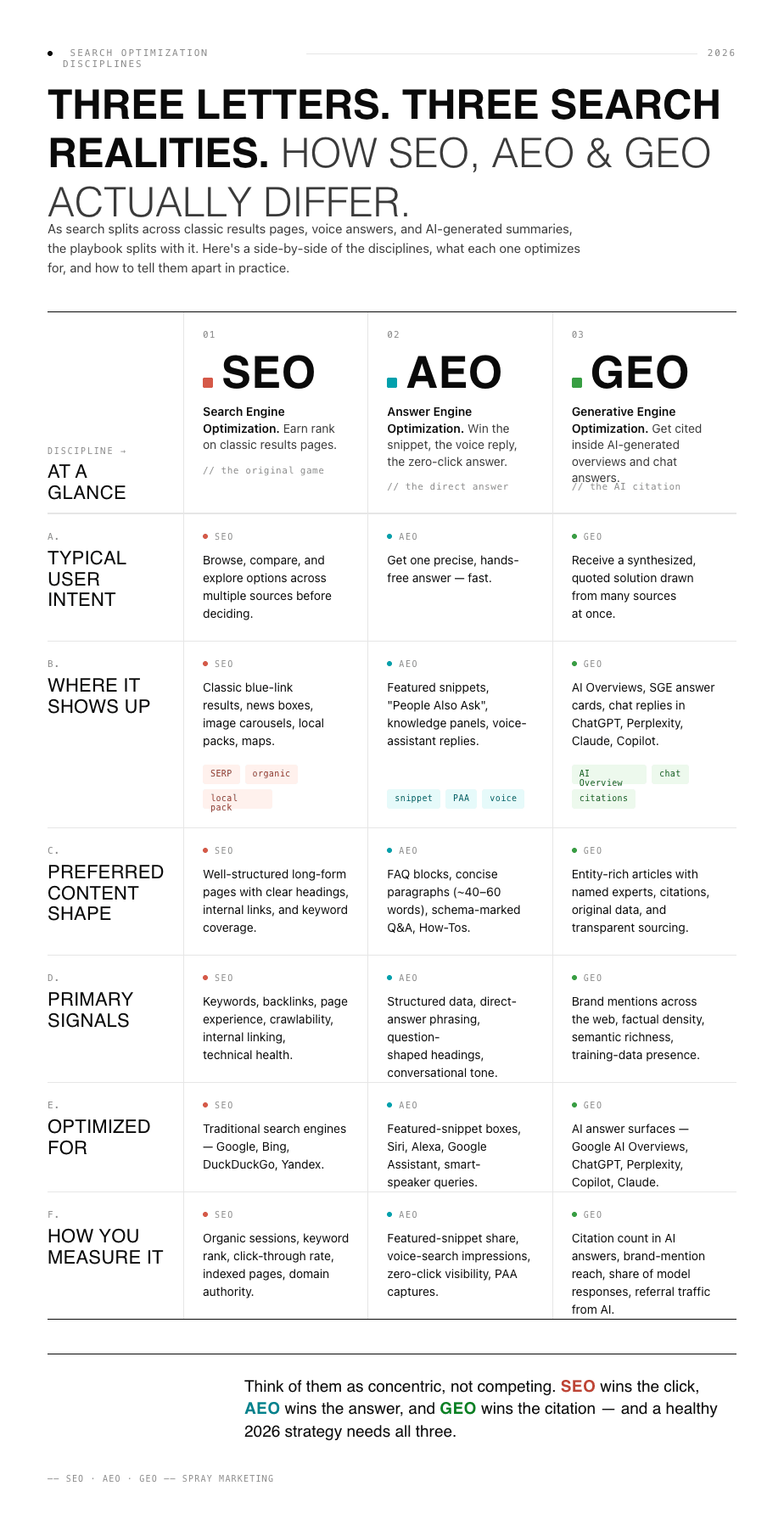
User behavior has split across all three surfaces, and the data on the zero-click shift is striking.
A 2025 Pew Research Center study, based on real browsing data from a panel of US adults, found that 58% of users encountered an AI Overview at least once during the month studied. When an AI Overview appeared on the page, users clicked a traditional search result only 8% of the time, compared with 15% on pages without one. That's roughly half as likely to click anything below the summary. Meanwhile, ChatGPT has reportedly reached around 800 million weekly users.
Add it up:
Each captures a different moment in the user's journey. Treating them as separate strategies is how brands end up dominant in one channel and invisible in the other two.
Here's the part most takes on this topic miss. SEO, AEO, and GEO aren't independent. They feed each other.
AI engines lean on search rankings. A SeoClarity analysis of more than 432,000 keywords found that 97% of Google's AI Overviews cite at least one source from the top 20 organic results, and Position 1 pages appear in AI Overviews more than half the time. Generative engines need some way to identify trustworthy sources, and high search rankings remain one of the strongest authority signals available. A solid SEO foundation isn't a legacy strategy. It's a prerequisite for showing up in AI answers at all. It's the same dynamic playing out across AI in marketing more broadly: the tool amplifies the strategy underneath it, it doesn't replace it.
Structured, answer-shaped content wins everywhere. The same characteristics that make content snippet-worthy for AEO (clear questions answered up top, scannable structure, FAQ sections, schema markup) are what make content easy for AI models to parse, summarize, and cite. Optimizing for one tends to lift the other.
Authority and brand mentions compound across surfaces. GEO leans heavily on what's said about your brand across the broader web: reviews, industry publications, mentions on Reddit and niche forums, expert commentary. Those same signals strengthen the E-E-A-T (Experience, Expertise, Authoritativeness, Trustworthiness) profile that Google rewards in traditional rankings. The PR and content work you do for one channel quietly improves your performance in the others.
In other words, you can't really do GEO well without doing SEO well. And the strongest AEO strategies are usually just well-executed SEO with extra attention to format and intent.
Imagine you publish a thorough, well-researched guide titled "How to choose a project management tool." Done right, that one asset can:
Getting there usually comes down to a few habits:
The acronyms are new; the principle isn't. People have questions. They turn to whichever tool feels easiest in the moment, whether that's Google, an AI Overview, a voice assistant, or a chatbot. Your job is to be the most trustworthy, well-structured, clearly authoritative answer they find, no matter which tool they reach for.
SEO, AEO, and GEO aren't three strategies to choose between. They're three views of the same one: be the source the world's information systems trust enough to surface. Get that right, and the channels mostly take care of themselves.

Let’s start with a conversation, and find out if you're a candidate for a FREE audit and growth plan.

